

What Does a Franchise Consulting Company Actually Do?
When Puddle Pools began its early expansion, the team followed a path many emerging brands choose. They worked with outside franchise consultants to help educate potential buyers and move conversations forward toward franchising.
The interest came quickly.
The alignment did not.
Though candidates arrived eager to learn, many of them still lacked a clear understanding of the model, the day-to-day work, and the expectations tied to ownership. The brand often had to repeat basic information and spend time correcting assumptions created earlier in the process.
CEO Mark Amery described the moment things changed:
“We are thrilled to take Puddle Pools to the next level with Franchise FastLane. Their reputation for responsible, accelerated growth, along with their unmatched team and infrastructure, makes them the perfect partner as we shift into advancing our expansion.”
That clarity did not come from using more franchise consulting firms. It came from a development partner that brought structure, purpose, and a steady process that traditional consulting support typically does not provide.
Understanding what a franchise consulting company actually does can help franchisors decide what kind of partner they need as their brand grows.
What Franchise Consultants Actually Do
A franchise consultant focuses on the buyer. Their role is to help individuals understand the world of franchise ownership so they can make an informed decision about their next step. Most consultants describe their work as educational. They explain how different franchise brands operate. They help buyers review franchise opportunities. They offer suggestions based on budget, lifestyle, strengths, and personal goals.
This support can be helpful for someone who is early in the process. Buyers often need a safe place to ask questions and explore what a franchise business might look like in real life.
A consultant usually provides:
- Information about broad categories in the franchise industry
- Conversations about financial ranges and the franchise fee
- Guidance for understanding personality fit and ownership style
- Introductions to the brands they are working for
These tools help potential franchisees understand the basics. They create a starting point. Yet they do not replace the structured development process a franchisor needs once interest begins to increase.
Where Consultants Usually Stop
A consultant stays focused on guiding individuals who want to learn about franchise ownership. Their role does not extend into the work that franchisors rely on when they begin to grow. They are not shaping the brand message, building a repeatable development path, or reviewing candidates for alignment. Franchise FastLane sees this often. Brands come to us with plenty of interest, but no structure behind it, and their teams are left carrying the weight of every conversation. Once that pressure builds, franchisors quickly realize they need a partner who can support the entire development process, not just the early education piece.
This is exactly where many franchisors begin to feel the gap.
When Zoom Drain was scaling, the brand experienced what happens when early conversations lack structure. Buyers entered discussions before they understood the expectations of the model. Franchisor teams spent time re-teaching information that should have been clear.
Rachel Dugan explained it simply.
“We had people coming through the pipeline who were not aligned. It created extra work because we had to go back and explain things that should have been clear from the start.”
Consultants helped create awareness. FastLane created alignment.
Why Franchisors Need More Than a Consultant
Consultants can help buyers learn. Brokers can introduce candidates. But franchisors need something entirely different when they want to scale with intention. They need a development system that protects culture and supports candidates through each stage of the franchising process.
This is where the difference becomes clear.
A franchise business consulting company focuses on explaining options.
A development partner focuses on the health of the brand.
FastLane partners exclusively with franchisors who have already demonstrated local success, have a solid foundation, and have a desire to grow their brand in a specific market in a sustainable and healthy way. FastLane builds a development path that sets clear expectations for candidates and gives franchisors meaningful support behind the scenes. With that framework in mind, we find that interest becomes easier to manage and the brand can grow without losing the standards that matter most.
“Healthy growth happens when the right people move forward at the right time.”
– Carey Gille, Co-Founder and CEO of Franchise FastLane
Inside FastLane’s Structured Approach
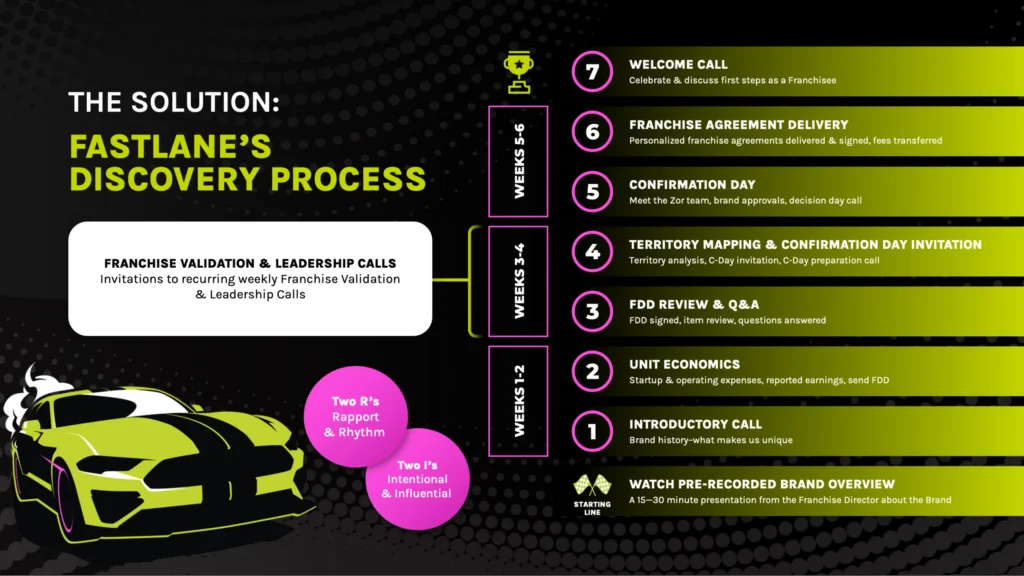
Franchisors tend to notice the shift as soon as they enter the FastLane process. They don’t begin with any kind of sales activity. Everything begins with a clear review of the brand, its goals, and the responsibilities placed on the future operators. Our team studies how the model works in real life, identifies what must be communicated up front, and builds a development path that matches those expectations. This approach gives franchisors a structure they can trust and gives candidates a realistic understanding of what ownership will require.
This creates a guided path where candidates feel informed, and franchisors feel supported.
FastLane’s system includes several pieces that work together:
- Education that walks candidates through how the model functions in real-world situations.
- A presentation approach that keeps the brand message consistent and in alignment with the franchisor’s values.
- An intentional qualification path built around culture, expectations, long-term success, and other intangibles.
- A timeline that guides candidates instead of rushing them
When all of these parts are in place, franchisors spend their energy on candidates who understand the opportunity and are prepared for ownership. Internal teams also feel the difference because they are no longer pulled into constant reactive conversations.
Mini Case Study: How EverLine Benefited From Structure
EverLine’s early buzz was great for visibility, but it pushed their internal team to the edge. Interest grew faster than the systems behind it, and conversations began piling up. The team worked hard to stay consistent with messaging, but the volume made it tough to keep everything on track.
Founder Holly Turkovic explained the feeling honestly when she said:
“Fear really had a grip on me because I thought that every time something challenging came up, I was going to be stuck.”
FastLane brought order to a moment that felt overwhelming. With a structured plan in place, EverLine could filter conversations, guide serious buyers, and protect its culture as it expanded. Once the structure settled in, they stopped wasting their time on conversations that didn’t provide the results they needed. That shift opened up time and energy the team needed to take care of their operators.
Mini Case Study: Tippi Toes and the Need for Alignment
Tippi Toes is known for its joyful culture and mission-driven leadership. Early interest from buyers brought excitement, but it also introduced stress behind the scenes. Conversations increased, and the brand needed a way to keep expectations consistent.
Franchise owner Brittany Mustybrook captured the heart of the brand perfectly when she said,
“From the beginning, it felt like a family to me. We are a network of strong, like-minded individuals.”
FastLane helped the founders refine the development process so the right candidates could rise to the top. The brand began attracting operators who valued the mission, supported the culture, and understood what it meant to join a purpose-driven franchise system.
Mini Case Study: How CarPool Prepares Brands for the FastLane
Some brands benefit from structured coaching long before they are ready for accelerated franchise development. That is why FastLane created CarPool, a program designed to help emerging franchisors build the fundamentals they need in order to scale responsibly.
Puddle Pools and Joshua Tree Experts both began in CarPool before stepping into the FastLane. They used the program to refine processes, improve their franchise development journey, and prepare for sustainable expansion.
Mark Amery shared how prepared his team felt at the time of their transition:
“With FastLane’s expertise and network, we are confident this next phase will create incredible opportunities for our brand and our franchisees.”
These brands grew responsibly because they began with structure rather than speed.
What This Means for Your Growth
If you are evaluating your options, it helps to remember one simple idea.
- A franchise consultant helps individuals learn about buying a business.
- A franchise consulting company helps buyers understand categories and opportunities.
- A development partner like Franchise FastLane helps franchisors build a system that supports long-term success.
You can clearly see how different brands have grown inside the FastLane system.
FastLane brings clarity to your process.
CarPool helps emerging brands prepare for growth.
Together, these programs support franchisors through every stage of their expansion.
If you want to strengthen your development systems or understand what sustainable growth should look like, our team is ready to guide you through the next step in your journey.
Frequently Asked Questions
1. What does a franchise consultant actually help with at the beginning of the process?
A franchise consultant can help interested franchisees learn the basics, but franchisors usually need more than that. When brands want structure and a clear development process, they partner with Franchise FastLane to create an intentional and healthy plan for growth with long-term sustainability in mind.
2. How do I know whether a consulting franchise or a development partner is the better fit for my goals?
A consulting franchise can show buyers a variety of brand options, but a development partner stays focused on the franchisor. If you want help building a system that protects your culture and attracts the right operators, Franchise FastLane provides that level of support.
3. What’s the difference between a franchise broker and a franchise consultant, and where does Franchise FastLane fit in?
A franchise broker introduces buyers to the brands they represent, and a franchise consultant focuses on helping buyers learn about franchising. Franchise FastLane works on the franchisor side, building the structured development systems that brokers and consultants do not provide. This helps franchisors attract aligned operators and grow responsibly.